
The Markers, Plainly Told
Every young person is already being measured. Grades, test scores, followers, likes, playing time, acceptance letters. The measuring never stops — the only question is whether the things being measured are the things that matter.
Here is what we think matters, told as plainly as we can tell it.
steamHouse works from a set of 78 Development Markers — a map of the capacities that evidence and experience keep converging on as most load-bearing for a conscious, purposeful life. Not a curriculum you sit through. Not a personality test. A map of what a forming person can actually build, made visible enough to build on purpose.
The markers come in three kinds, because that's how development shows up where you can actually watch it: in who someone is becoming, how they think, and what they can do.
Stars, Lenses, Keys
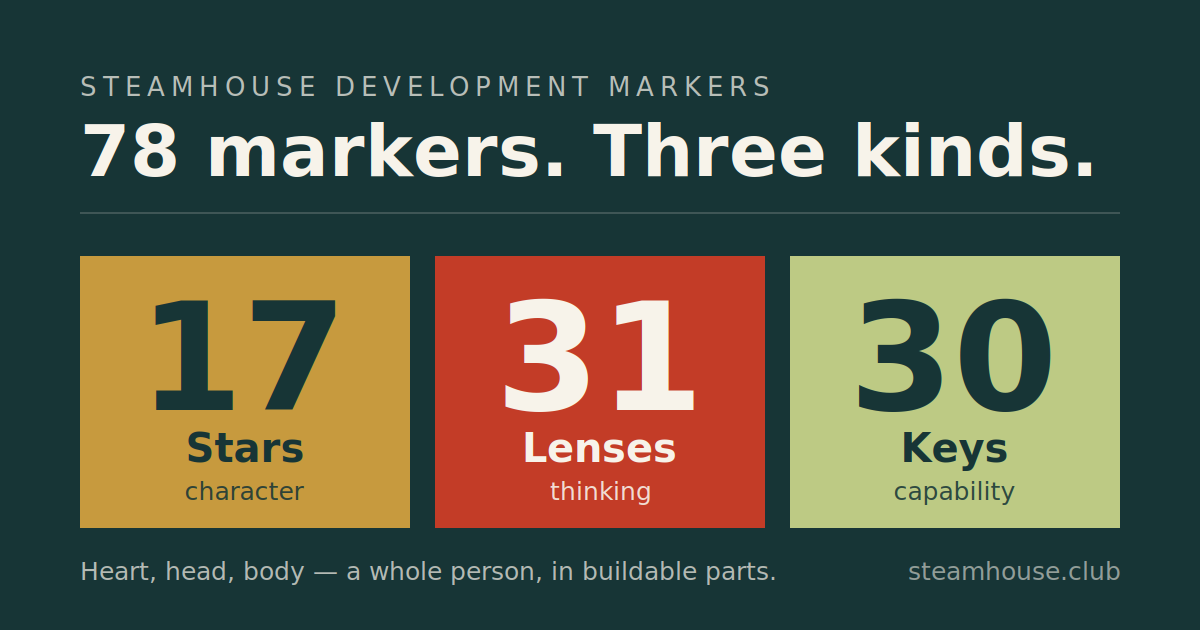
Stars measure character — who you are becoming in relation to your own values. There are seventeen of them. A Star is not a personality trait; traits are what you inherit, character is what you build. A Star is earned when the quality shows up under conditions where it would be easier not to show it — when honesty is inconvenient, when courage is costly, when care requires something real. Curiosity is a Star. So is keeping a heart at peace toward someone you disagree with. So is giving first, before you know what comes back.
Lenses measure thinking — thirty-one mental frameworks that shape how you understand the world. Here the distinction that matters is encountered versus mastered. It is entirely possible to read about systems thinking and possess no systems-thinking capacity whatsoever; every adult knows someone fluent in ideas they cannot use. A Lens is earned when a framework has moved from concept to tool — when you reach for it without prompting because it has proven itself in your actual life. Telling a fact from the story you've built on top of it is a Lens. Asking "how likely is it, really?" is a Lens. Knowing the edges of what you know is a Lens.
Keys measure capability — thirty things you can do, consistently, under real conditions. Skills untested are not skills yet. A Key is earned through practice, not exposure: managing your attention, running a hard conversation, handling money on purpose, holding a role on a team when the team is struggling. The body of competence a capable adult quietly runs on — named, so it can be built.
Seventeen Stars, thirty-one Lenses, thirty Keys: 78 markers. Character, thinking, capability. Heart, head, body. A whole person, in buildable parts.
Where the markers come from
Underneath all 78 sit four core principles: Reflective Thinking, Personal Agency, Mutual Respect, and Objective Reason. Every marker is an expression of at least one of them. The principles are the root system; the markers are what grows where a young person can reach it.
None of this is invented from scratch, and that is the point. Nearly every marker traces to published work — researchers, practitioners, and traditions that each mapped a piece of the territory. What steamHouse adds is the assembly: one coherent, teachable architecture instead of seventy-eight scattered good ideas. First principles, not final answers — the map is a curated starting point, held open to revision, not a closed canon.
When the markers come online
A seven-year-old and a seventeen-year-old are not building the same things. So the 78 markers are also organized across three developmental stages — a map not just of what to build, but of when it naturally builds.
The early stage — we call it Agent-Habits — is the ground floor: the foundational habits and orientations a young agent runs on, concrete enough to practice daily. The middle stage, Artist-Tools, is where most of the Lenses live: the thinking frameworks a maturing mind can actually wield, picked up as they become useful rather than memorized in advance. The third stage, Hero-Ideals, belongs to the late teens — the years of grappling with meaning, where the work is no longer acquiring capacities but living values and exercising real agency in the world.
The stages are emphases, not gates. A ten-year-old can be genuinely curious at a level many adults never reach; a sixteen-year-old may still be building an eight-year-old's habit. The sequence describes where the center of gravity naturally sits, so that mentors teach what a young person can currently reach — and so nobody mistakes a kid for behind when they are simply mid-build.
The ladder: how a marker is actually developed
Naming a capacity is the easy part. The harder question — the one most systems never ask — is how deeply do you have it? Two kids can both be described as curious: one can tell you what curiosity is, the other rearranges her afternoon to chase a question nobody assigned. Same marker, different rung — and the rung is what tells you where the kid actually is. Every marker develops through the same four levels. I coached robotics teams for fourteen seasons; here is what each rung looks like when you watch it happen.
Knowing It. You understand the capacity. You can explain it, recognize it, talk about it accurately. This is where most education stops — recall and reproduction — and it is the beginning of development, not the end.
I once coached a four-kid team — two strong programmers, two strong builders — who had chosen each other, explicitly and emphatically, as a crew. It didn't save them. All season they struggled to agree on solutions, each so attached to their idea that the best idea couldn't get a hearing. So we talked — the five of us, pullout conversation after pullout conversation, working through what good teamwork actually asks. At the tournament, they won the Core Values award. The judges were struck by how insightfully they could talk about collaboration. They could. They'd earned every word of it. They just couldn't yet do it.
Using It. The capacity works under real conditions — applied when it counts, though maybe only when prompted, and not yet reliably. This is where competence forms, and it only forms in situations with real stakes. Worksheets don't reach it.
One season, a team decided the week of the tournament that their robot wasn't good enough — and completely rebuilt it. I didn't know until the dismantling was already done. I was genuinely concerned, and would have counseled strenuously against it. For the record: the new robot didn't perform especially well. But the call was theirs to make — that was the design. And look at what's inside it: an honest read of their own work, made against every comfortable reason to protect what they'd built, with the deadline bearing down. A capacity deployed under real conditions — not yet mastered. Using It, exactly.
Living It. The capacity shows up without prompting, consistently, because it has become part of who the person is. This is where character forms. Nobody is checking. It happens anyway.
Kids came in on their lunch. Nobody asked them to, and it happened again and again. Lunch is the one block of a school day that belongs to the kid — the part nobody else has a claim on — and they spent it on the robot. That's the rung. Not what a young person does while the program is watching; what they spend their own time on when it isn't.
Passing It On. A person can develop the capacity in someone else — the highest level of mastery, because it requires understanding a thing from multiple angles, catching misunderstandings before they harden, and holding another person's growth with patience. A young person who reaches Passing It On has stopped merely accumulating development and become a source of it. That is why we treat it as the culmination: generativity is the natural endpoint of genuine growth. The formed life turns outward.
I had one student for three years — a sweet, capable, slightly awkward kid who found his footing on the robotics team. Call him Hugo; that's not his real name. When he moved up to the high school on the other side of our shared campus, I figured that was that. Then he asked to come back as an assistant coach. All season he walked back over to the middle school he'd outgrown and spent his time developing in younger kids the things the team had developed in him. He'd stopped accumulating development and become a source of it.
Most scoreboards young people live under measure Knowing It and call it done. Hugo's Core Values counterpart — the team that could explain teamwork beautifully — won an award on that scoreboard. The ladder is the difference between a program that informs and an environment that forms.
What this is not
Not grades in costume. Grades rank students against each other on recall. Markers describe one person's actual capacities, at an honest level, against no one.
Not gamification. There are no points, streaks, or leaderboards, because the entire framework exists partly because engineered reward loops are doing so much damage to young attention. A marker is recognized on behavioral evidence — what a mentor or the young person can actually point to — not performed for a counter.
Not a checklist to complete. Seventy-eight is a map, not an assignment. No one develops all of them evenly, and the map is explicitly not exhaustive — it is the set we can currently defend, organized so a well-prepared mentor can teach it without specialized credentials and a family can use it at the dinner table.
Not finished. In the honest-ledger spirit: the marker architecture is fully built and in use in our own programs; the credentialing platform that would make marker attainment portable and verifiable to outside institutions is under development, not live. We say so because a framework about honest self-assessment should probably model some.
Why bother making it visible
Because the invisible version already exists and is unfairly distributed. Some kids inherit these capacities the way you inherit an accent — absorbed from households that had them to give. Naming a capacity, describing what it looks like in practice, and giving a young person language for it converts an inherited advantage into a developmental target anyone can aim at. A scoreboard you can see is a scoreboard you can work.
And because what gets named gets noticed. A parent who has the word for it sees the moment their kid tells fact from story at the dinner table. A mentor who has the ladder stops mistaking can explain it for has it. The markers don't add anything to a young person that wasn't possible before. They make the possible legible — to the kid most of all.
If you want to try the framework tonight, it costs one question. Pick any capacity you wish your kid had more of — patience, follow-through, telling fact from story — and instead of asking whether they have it, ask where on the ladder it currently sits. Can they explain it? Do it when prompted? Do it unprompted? Teach it? The answer is almost never "nowhere," and the next rung is almost always visible from the current one. That reframe — from a verdict to a location — is the whole method in miniature.
If you want the whole map, it's open: every Star, Lens, and Key, with its sources and its place in the architecture, lives in the Marker Explorer. Start anywhere. That's rather the point.